
Driving in Finland
Traffic Rules and Speed Limits for Driving in Finland
Finland's road rules are not exotic, but a few of them are organised differently from what drivers from other countries expect. The most common question from newcomers concerns speed limits, because the number that applies depends on where you are, not just on how the road looks.
Traflicom · Mannerheimintie 117, 00280 Helsinki · +358 9 4241 8820
The posted number is where you are, not how the road looks.
A familiar stretch of asphalt can carry a different limit on each side of a village boundary. Read the signs, not the memory of the road.
Speed limits depend on context
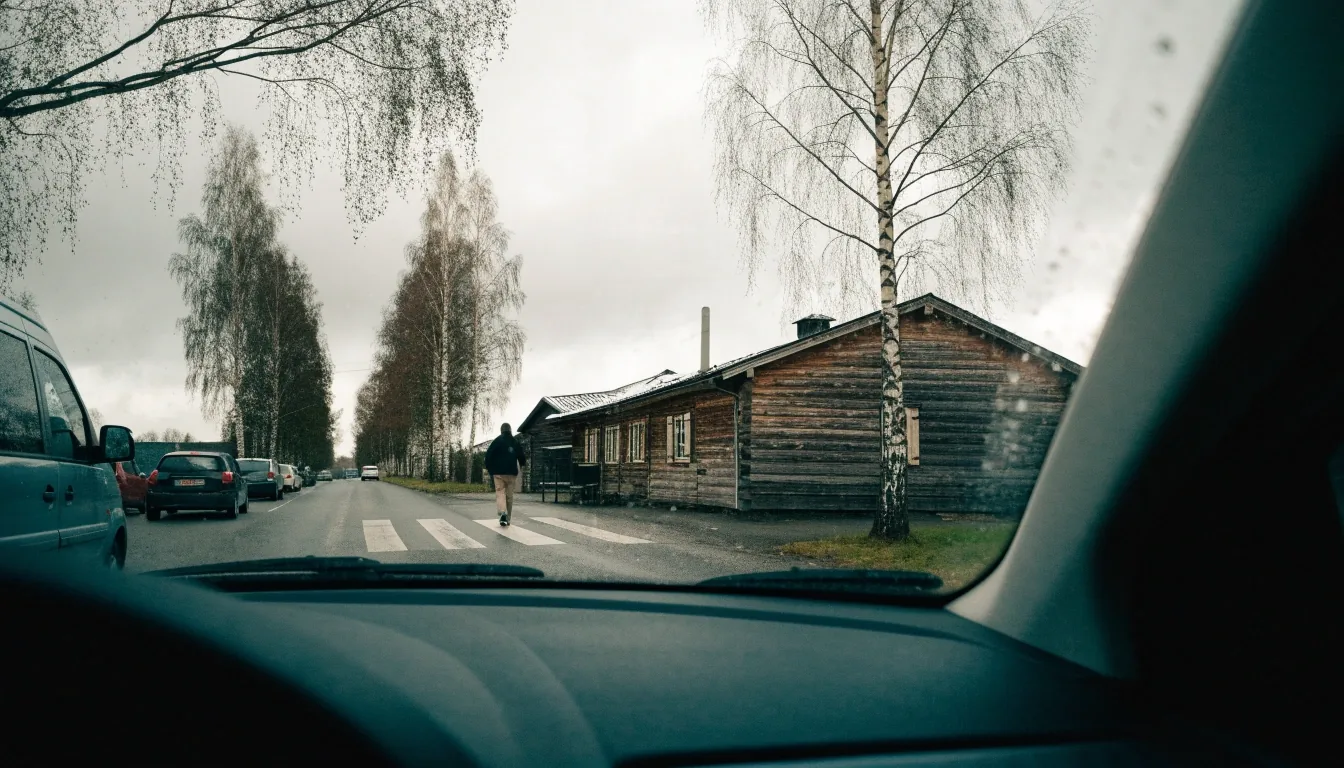
Finnish speed limits vary by road type and by settlement context. The critical distinction is whether you are inside or outside a built-up area. The same stretch of asphalt can carry a different limit depending on that boundary, which is why relying on memory of the road rather than the posted signs leads to surprises. When in doubt, the sign governs.
Signage is in km/h throughout the country, with no dual units and no exceptions for foreign plates. If your car's instrument cluster is set to miles, change it before you drive rather than doing arithmetic in traffic.
Typical limits outside built-up areas
- Main highways and motorways typically 120 km/h in summer, lower in winter
- Ordinary rural main roads usually 80 km/h, raised to 100 km/h on some stretches
- Gravel and small connecting roads commonly 60 or 80 km/h, sign by sign
- Inside a built-up area 50 km/h as a general rule, with 30 or 40 km/h zones in centres
These are the figures you will meet most often, published in public English-language traffic guidance. Individual roads are always governed by the sign standing at the roadside, including temporary limits at roadworks.
Typical limits and conversions
Public English-language traffic guidance gives typical limits for roads outside built-up areas in both km/h and mph, which is useful for drivers whose car or instincts are calibrated in miles. A converter in your head is not reliable at speed; learn the handful of round numbers you will actually see and match them to what the signs show.
Learn this table instead of the formula. The right-hand column is what your speedometer shows when the sign says the number on the left, near enough to drive by.
| Posted limit | Shows as, roughly | Where you meet it |
|---|---|---|
| 30 km/h | about 19 mph | Residential streets and school surroundings |
| 40 km/h | about 25 mph | Town centres and dense housing areas |
| 50 km/h | about 31 mph | Inside a built-up area, unless a zone sign says otherwise |
| 60 km/h | about 37 mph | Smaller connecting roads and some suburban stretches |
| 80 km/h | about 50 mph | The default outside built-up areas on ordinary roads |
| 100 km/h | about 62 mph | Selected main roads in good conditions |
| 120 km/h | about 75 mph | Motorways in summer; winter limits are dropped |
The mph column is a rounded reading for orientation only. If it ever disagrees with what you remember, the sign is right.
Built-up areas
Inside built-up areas the limits are lower and the environment changes faster: pedestrians, cyclists, crossings, and side streets. The settlement boundary is marked, and it matters. Drivers used to wide arterial roads at home sometimes carry that expectation into a Finnish town centre.
The rule set here is designed around the reality that people appear from between parked cars. Approach a crossing at a speed where you could stop for someone you have not seen yet, and keep an eye on tram and bus lanes, which are restricted to specified vehicles.
Watch the boundary sign
The built-up area marker lowers the limit. Leaving the boundary raises it again, but not always by the same amount, so keep checking.
Expect crossings close together
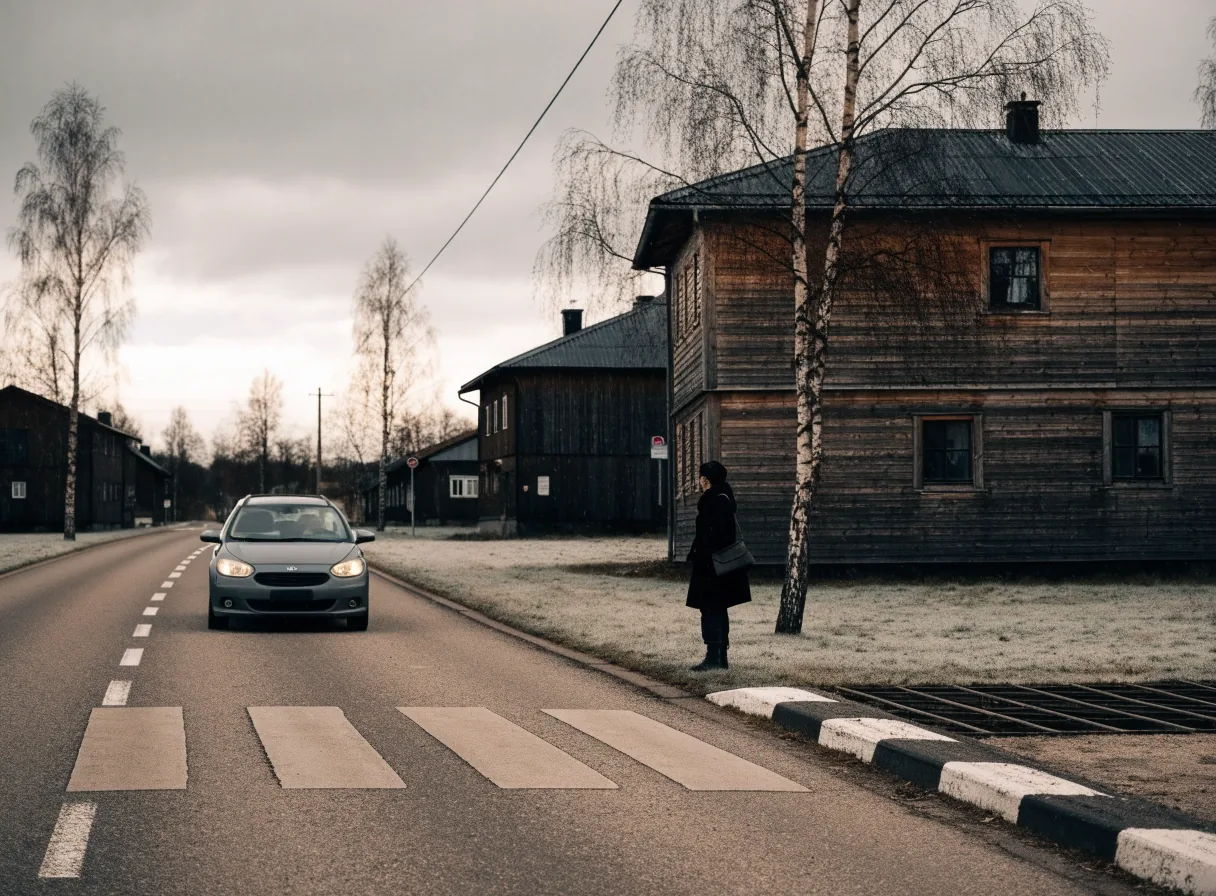
Zebra crossings in a centre can sit only a few car lengths apart, with pedestrians already stepping out as you approach.
Give cyclists real room
Cycle traffic is dense in Finnish towns, and a passing distance that feels generous at home can feel close here.
Winter and conditions
Finnish driving includes months of low grip, short daylight, and road surfaces that change character between morning and evening. The posted limit is a maximum for good conditions, not a target for bad ones. This is one place where the law and common sense point the same direction: adjust to the surface, the visibility, and the traffic around you rather than to the sign alone.
Winter speed limits are lowered on the roads where the higher summer figures apply, and studded and friction tyres each have their own requirements for the season. When a limit is dropped for winter, treat the summer number as history. Keep your lights on through the dark months, leave a longer gap to the car in front than you would in June, and expect the first cold mornings to reveal black ice on bridges and shaded stretches before it appears anywhere else.
If you are new to driving on snow, the useful habit is to reduce speed before the change in surface, not after. Braking and steering at the same time is what catches people out, whether the car has studs or not.
Rules newcomers trip over
Right-of-way habits, roundabout discipline, and the treatment of pedestrians at crossings differ in detail from country to country, even within Europe. Rather than list every divergence, the practical approach is to observe the first weeks carefully and assume the local convention is deliberate. When something feels ambiguous, slow down and let the situation resolve.
- Right of way on unmarked junctions
- Where no signs or markings decide it, the right-hand rule still applies in Finland. At an unmarked crossroads the vehicle coming from your right has priority, so read junctions rather than assume main-road status.
- Roundabouts
- Traffic on the roundabout has priority and you indicate on the way in and out. Indicate left on the approach if you intend to take the first exit, and always signal right as you leave, including the exit that continues straight.
- Pedestrians at crossings
- A pedestrian at or about to step onto a crossing has priority over turning traffic. Where a car turning into a side road meets a crossing, the walker goes first even if you have a green light.
- Lights, day and night
- Headlights are required in all conditions, not only after dark, for the whole year. Modern cars usually handle it automatically, but check that the setting survives a service.
- Trams and bus lanes
- In Helsinki and Tampere the tram has priority over other traffic, and bus lanes carry vehicle category restrictions. Do not drift into a lane just because it looks empty.
- Parking and studded tyres
- Street parking in a district usually needs a resident or paid permit, and studded tyres carry their own seasonal dates. Read the local signs rather than copying the car in front.
Where the rules come from
The rules described here follow Finland's publicly available traffic guidance and are written for practical driving rather than for a theory exam. If you are preparing for a Finnish driving test or a licence exchange, use the official materials for that purpose. This page is meant for the driver who already holds a licence and needs to operate safely and legally on Finnish roads.
Where the two purposes overlap, the official wording is the one that counts. Our role is to explain what a limit or a rule expects of you in the moment, and where a general answer stops being useful for your own vehicle or route.
Where this sits on Traflicom
Traflicom explains Finnish vehicle registration and road rules in English, alongside the paperwork that usually brings people to us. If your question turns out to be about registering, importing or taking a car off the road, it belongs on one of these pages.
-
Registering a Vehicle in Finland
First registration, käyttöönotto and what the documents contain.
-
Importing a Vehicle to Finland
The tuontiajoneuvo route from arrival through inspection.
-
Ownership Changes & Decommissioning
Omistajanvaihdos and poistaminen liikennekäytöstä.
Questions that come up a lot
Short answers to the points drivers ask about most often. If your case is narrower than these, send it to us and we will say what the rule expects.
Which limit applies if I cannot see a sign?
Inside a built-up area, 50 km/h applies unless a zone or local sign says otherwise. Outside built-up areas, 80 km/h is the general limit on ordinary roads, and higher figures only where signs allow them. A missing sign is not permission to guess upward.
Do winter limits replace the summer ones everywhere?
Winter reductions apply to the roads where the higher limits are used, mainly main roads and motorways. Streets and smaller roads keep their year-round limits, but conditions still govern how fast is sensible.
I have a foreign licence. Do the same rules apply to me?
The road rules are the same for everyone driving in Finland, whatever the licence. What differs is the paperwork around your licence and vehicle, which is a separate question from how you drive.
Does a trailer or caravan change the limit?
Towing combinations have their own maximum speeds and equipment requirements, and those can be lower than the general limit on the road. Treat the lower of the two as your ceiling, and check the combination rules before a long trip.
What if a temporary limit at roadworks contradicts the sign I remember?
Temporary limits stand for as long as they are posted, and they override whatever the road normally allows. Slow to the temporary number for the whole stretch, not only past the machinery.
My question is about one junction. Can you answer that?
Often, yes. Give us the direction you were travelling, the signs and markings you saw, and any other road users involved. We will explain what the rules would expect, and say plainly where the situation is genuinely ambiguous.
If you are unsure about a specific situation
Some questions, a particular junction, a vehicle category, a towing combination, are too specific for a general page. Describe the situation in a message and we will explain what the rules say and where the ambiguity lies. We will not tell you what an officer would decide on the day, but we can usually tell you what the rule expects.
- Address
- Mannerheimintie 117, 00280 Helsinki, Finland
- Phone
- +358 9 4241 8820
- [email protected]
- Hours
- Monday–Friday, 9:00–18:00